
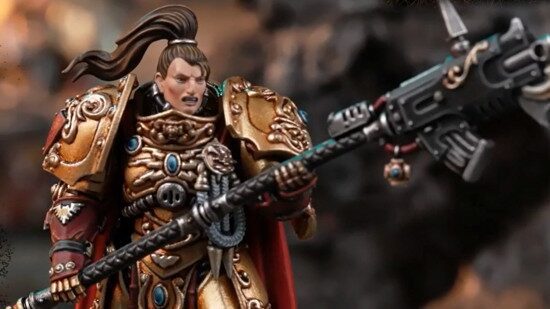
Few franchises argue with themselves as fiercely as Warhammer 40,000. Built on decades of dense lore, competing interpretations, and deeply invested fans, the setting has always been resistant to change. Even more so when that change touches foundational factions. The recent introduction of officially confirmed female Adeptus Custodes has proven to be no exception.
Lore Retcon or Long-Standing Canon?
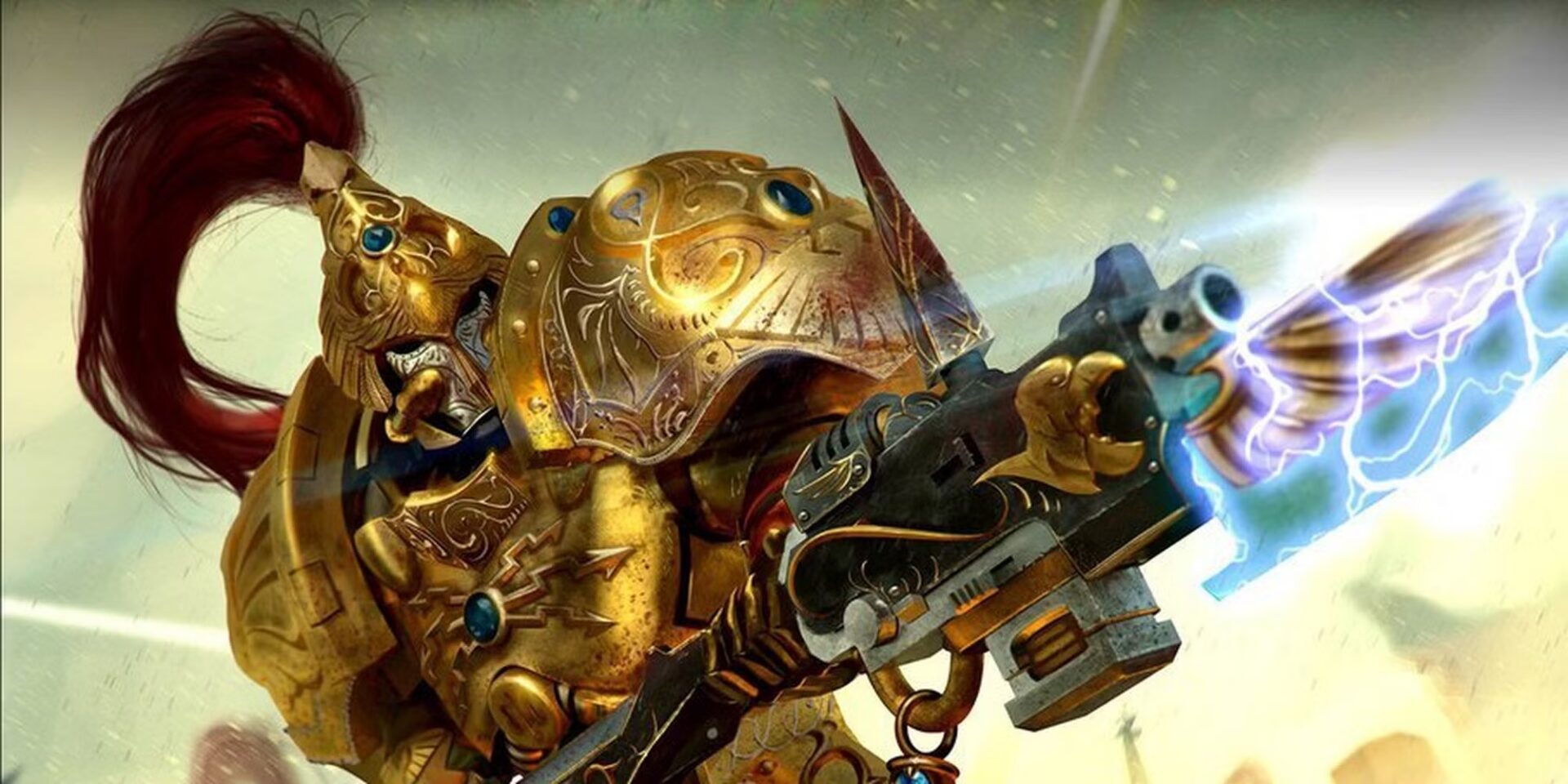
In April of 2024, Games Workshop released the 10th Edition Adeptus Custodes Codex, which included a short story explicitly referring to a Custodian using female pronouns. Shortly afterward, Games Workshop responded to fan questions on social media by stating that “there have always been female Custodians since the first of the 10,000 were created.” This marked the first time female Custodians were formally acknowledged in canon.
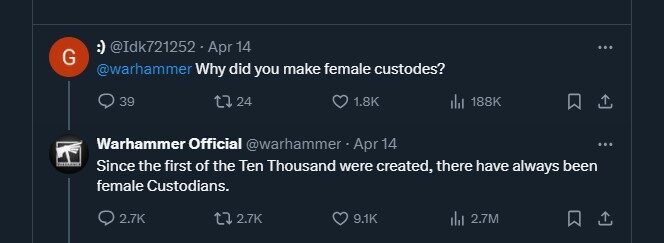
The response was immediate and sharply divided.
For many longtime fans, the issue was not the presence of female characters in Warhammer 40K—a setting already home to prominent female factions like the Sisters of Battle and Sisters of Silence, the latter of which were already deeply tied to the Emperor’s Custodes—but the manner in which the change was introduced.
The Custodes have historically been portrayed as a singular, hyper-specialized brotherhood: genetically engineered companions of the Emperor, distinct even from the Adeptus Astartes. Critics argue that retroactively asserting the existence of female Custodians without prior textual evidence amounts to a lore retcon delivered without sufficient narrative groundwork.
Measuring Fan Reaction
One flashpoint in the debate has been the claim that opposition represents only a “small and feeble minority.” This characterization, notably echoed in a Wargamer article celebrating the introduction of female Custodian miniatures, has itself become controversial.
Critics point to engagement metrics on Games Workshop’s official announcement video, where visible dislike ratios significantly outweighed likes at the time of release. While such metrics are imperfect indicators of overall community sentiment, they complicate assertions that resistance was marginal or inconsequential.
What emerges instead is a fandom split, not simply over the models themselves, but over how dissent is framed and discussed.
Journalism, Consensus, and Credibility
The controversy has extended beyond Games Workshop and into games media. Several critics have focused their ire on Wargamer, arguing that its coverage reflects a broader problem in modern hobby journalism: a perceived lack of ideological diversity and editorial debate.
One Wargamer writer openly acknowledged that the lore change was inelegantly handled, while simultaneously arguing that fans should accept it as a business decision beyond their control. For detractors, this stance reads less as thoughtful analysis and more as resignation—a signal that critique is acceptable only up to a point.
Tensions escalated further following the publication of an article written by a Wargamer contributor who stated she had never previously played Warhammer 40K, but felt motivated to start because of the new female Custodian models. To critics, this raised uncomfortable questions about expertise, audience alignment, and whether the hobby is increasingly being interpreted by voices outside its core participant base.
Moderation, Community Spaces, and Free Expression
Adding fuel to the fire are reports that certain online communities—including the r/AdeptusCustodes subreddit—have issued strict moderation policies banning negative discussion of female Custodians. Supporters argue these measures prevent harassment and bad-faith discourse; opponents view them as evidence of ideological gatekeeping.
The result is a feedback loop: fans who feel silenced retreat to alternative platforms, while mainstream outlets cite those spaces as proof of toxicity, further justifying stricter moderation.
At its core, the female Custodes debate is less about the miniatures and more about trust—both to the lore of the setting and the fanbase.
Longtime fans question whether Games Workshop and hobby media still understand what made Warhammer 40K resonate in the first place. Meanwhile, supporters of the change see resistance as an unwillingness to allow the setting to grow or reflect a broader audience.
Neither side is likely to convince the other, which may be the real takeaway. Warhammer 40K has reached a cultural scale where consensus is no longer possible. What remains to be seen is whether the franchise can sustain creative expansion without alienating the audience that carried it there.